
ITServiceMgmt.com_Logo

Bridge Strategy and Operations with Clear, Costed, and Owned Services

For over two decades, I’ve watched IT departments hide behind “green uptime” while frontline crews and service desk teams struggle with broken tools and confusing naming conventions, and CFOs demand to know where technology budgets actually go.

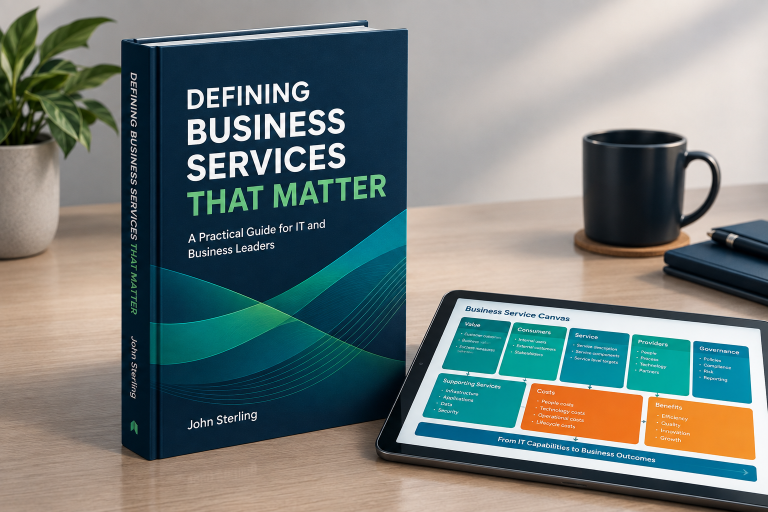
Defining Business Services That Matter was written to end that disconnect. Grounded in real-world enterprise experience, service taxonomy architecture, and IT cost models, this service method gives you the exact tools to move your monolithic systems out of the dark ages. This book isn’t AI-generated slop divorced from real-world IT, it’s about defining services your business owners, finance partners, and customers actually understand.

Define your services clearly. Know what customers expect. Then plan, budget, operate, measure, and improve with confidence.

Stop Managing Systems. Start Running Business-Aligned Services.

Why Managing Business Services Outweighs Managing Systems & Applications

Managing technology as a collection of isolated software applications and server stacks is the root cause of the disconnect between IT, Finance, and the Business. When IT reports “99.9% green server uptime” while frontline crews can’t operate and CFO’s challenge the budget, system-centric management has failed.

Business Service Management (BSM) shifts the focus from raw infrastructure to value co-creation. Here is why service oriented governance transforms organisations.

Outcomes Over Outputs (Escaping the Green SLA Trap)

  • Managing Systems. Focuses on technical “goods” database pings, patch cycles, and server availability. The system is “green,” but the business is frustrated.
  • Managing Services. Focuses on business capabilities dispatching site crews, processing medical images, or issuing compliance reports. You measure what the business actually experiences.

Transparent TCO Over Black Box IT Bills

  • Managing Systems. Bundles hardware, vendor contracts, and labor into generic, unexplainable General Ledger IT towers. Budget reviews become defensive arguments.
  • Managing Services. Slices GL spend into standardised cost pools mapped directly to service offerings. Business owners see the exact unit cost to serve.

True Accountability Over Finger-Pointing

  • Managing Systems. Lists IT system admins as “owners” of applications they don’t control from a business outcome perspective.
  • Managing Services. Establishes a clear RACI boundary between the Business Service Owner (accountable for value, budget, and roadmap) and the IT Service Owner (accountable for technical delivery and SLAs)

About John Sterling & The BSM Framework

Bridging the gap between what IT thinks it delivers and what the business actually experiences.

Service has been the thread running through my entire life.

Back in the 1970s, I delivered newspapers mornings, evenings, and weekends. From there, I took a job at a local garage serving customers face-to-face at the petrol pump, eventually moving inside to run the till. Those early years taught me a fundamental truth that has guided my career ever since, delivering a great service is always about clarity, care, and human connection.

Later, I moved into technology sales, selling high-end digital workflow software back when enterprise software was still a novel concept. Over the past two decades, I’ve held leadership and advisory roles across IT Service Management (ITSM) and Technology Business Management (TBM) in heavy industry, mining, and field operations.

Why This Book & Platform Exist

Throughout my time in enterprise tech, one persistent disconnect kept surfacing. IT departments routinely hide behind “99.9% green server uptime” while frontline site crews struggle with broken tools and CFOs demand to know where technology budgets actually go.

Traditional frameworks often treat IT like a secretive black box, defending costs with gut feelings or over-engineered jargon. Defining Business Services That Matter was written to end that black-box culture.

This platform isn’t built on academic theory or AI-pumped content farming. It is forged from 25 years of site-floor friction, Service Taxonomy, database architectures, and cost model frameworks. My goal is simple, to give IT leaders, business owners, and finance teams the shared language, blueprints, and confidence to define, cost, and own services that genuinely matter.

1. Human-Centered Service Logic. A service isn’t an application label on a screen, it is a supported facility backed by an ongoing human commitment to customer felt experience.

2. Absolute Financial & Operational Clarity. Slicing General Ledger IT towers into transparent cost pools so every stakeholder understands the exact cost-to-serve.

3. Practical Execution Over Hype. No chasing buzzwords or 50-page shelf-ware documents, just 2-page Business Service Canvases and pragmatic workflows that work on the ground.

Latest Blog Posts

Forged in Real-World Operations, Not Academic Theory

The Business Service Management (BSM) framework isn’t an academic exercise or an AI-generated template. It was forged on the site floor in high-stakes environments, where mobile tablets fail on 5G crushing gantries, regulatory compliance audits carry millions in penalty risks, and CFO’s demand absolute financial line-item clarity.

Whether you’re managing complex industrial field operations, healthcare delivery stacks, or enterprise rollouts, this playbook cuts through corporate jargon to simplify complexity and build services that work in practice.

Bring the BSM Framework to Your Leadership Team

Ready to break the "SAP Trap," draw defensible service boundaries, and align your IT, Finance, and Business Owners around clear service taxonomy and cost model? Explore our workshop-in-a-box assets, download Chapter 1, or invite John to facilitate a high-impact executive scoping session for your organisation.

Two people sat at a desk shaking hands discussing ITSM and TBM

Connecting the Server Room to the Boardroom

A Trusted Partner for Your IT Services

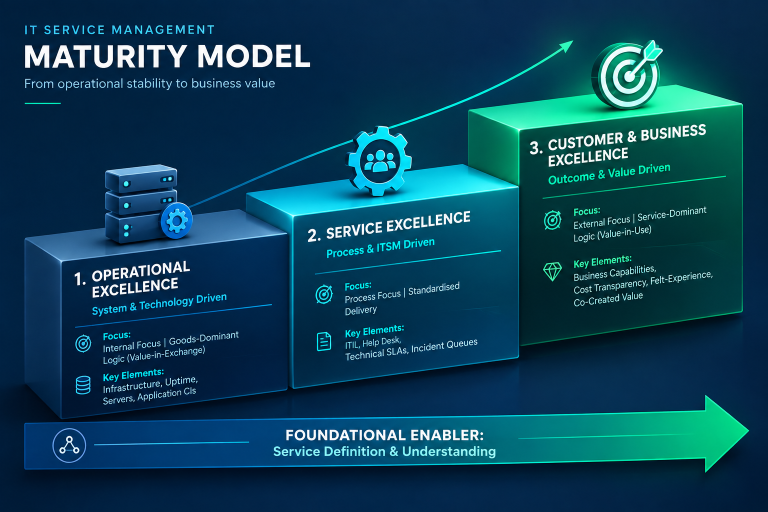
Traditional IT Service Management (ITSM) focuses on the “plumbing”, keeping server infrastructure green and ticket queues moving. But business leaders don’t buy “database uptime.” They buy operational outcomes, dispatching site crews, generating compliance packs, or processing clinical images.

By aligning ITSM delivery frameworks with Technology Business Management cost models, we help organisations turn raw General Ledger technology spend into clear, offering-level TCO. The result? Business owners take true accountability for their capabilities, finance gets line-item transparency, and IT transforms from a defensive cost center into a strategic partner.